• About Us
  • Pricing
  • Preparation
  • Scheduling
  • Important Details
  • Search
  • Contact
  • Locations To Get Imaged By Candace
  • Blog
RADIANT BODY THERMOGRAPHY

Stay Radiant ~ Screen Safely!

  • About Us
  • Pricing
  • Preparation
  • Scheduling
  • Important Details
  • Search
  • Contact
  • Locations To Get Imaged By Candace
  • Blog

We're Imaging at Veg Fest Again This Year!

This year we have a very private photo booth and are doing breast scans for anyone who wants to get screened AND benefit Veg Fest.  We're donating $5 for each breast scan at the show to NW VEG, a non-profit dedicated to animal rights issues.

We'll display examples of thermal patterns that have improved on plant-based diets.

See you at the show!!!


Veg Fest is held at the Oregon Convention Center.  The dates are October 14-15, 2017.

For tickets, click here.

Saturday 10.07.17
Posted by candace parmer
 

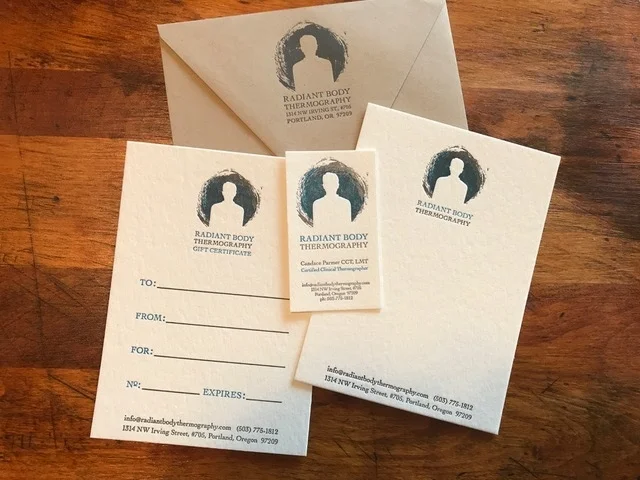
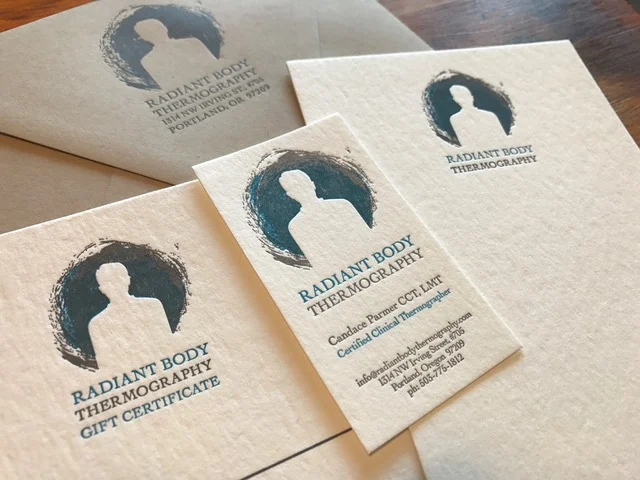
Give a Gift of Health - an Infrared Imaging Report of Their Radiant Body!

Email or call us at 503-775-1812 if you'd like to send your loved one this beautifully printed gift certificate.

2017-07-06 16.58.51.jpeg
2017-07-06 16.58.57.jpeg

All this lovely printing work was done by Jenn Lawrence at Letterpress PDX.  Thanks Jenn!

Sunday 09.24.17
Posted by candace parmer
 

Thermal Thursdays! July 14, July 21, July 28


We've reserved a free consultation for you or your loved one!  We’ll take a free thermal picture of you.  You’ll learn about thermal imaging and how it can give you real time information about your state of health.


July is about Thermal Thursdays... call for your appointment: 503-775-1812.


Experience thermal imaging. 100% safe screening, no radiation, compression or pain!  Got pain or just curious?  Make an appointment for a Thermal Thursday free consultation.

Thursday 07.06.17
Posted by candace parmer
 

Why We're Not on Facebook Anymore

Several months ago, I got a recommendation from FB that I "be friends" with a recent thermography client.  I knew immediately that FB was invading my computer to see patient information, so I immediately deleted our FB page for client privacy.

Other privacy measures we take are encrypted emails and password protected medical reports sent via HIPAA compliant encrypted email and fax.


Monday 03.06.17
Posted by candace parmer
 

Deceiving Numbers Used Regarding Mammography's Effectiveness

For every 1000 "not-screened" women, 5 will die of breast cancer.  For every 1000 women screened, 4 will die of breast cancer anyway, regardless of mammography screening.  This is the 20% risk-lowering benefit claimed by mammography proponents. 

Mammograms are said to cut the risk of dying from breast cancer by as much as 20 percent, which sounds like an invincible argument for regular screening. Two Maryland researchers want people to question that kind of thinking. They want patients to reexamine the usefulness of cancer exams, cholesterol tests, osteoporosis pills, MRI scans and many other routinely prescribed procedures and medicines.

Screening is a CHOICE!  Make yours a safe one.  Consider thermography, 100% safe, better sensitivity in dense breasts, no pain, compression, contact or radiation of any kind.

Wednesday 01.25.17
Posted by candace parmer
 

NPR: Danish Study Raises More Questions About Mammograms' Message

Link to article  - NPR Interview included in link

Excerpt: 

"We wanted to look at whether breast screening led to fewer advanced-stage cancers because screening is really based on the premise that you detect cancer earlier so you should have less advanced cancers over time," Jorgensen says.

But the analysis found that there was no "reduction in the frequency of late-stage tumors in the screened areas compared to the non-screened areas," Jorgensen says. "But we did see a huge increase in the occurrence of early-stage cancers."

The findings suggest mammograms are frequently picking up lumps that would never become a health problem. Like many prostate cancers, they may never grow or may even regress on their own.

"That means that these essentially healthy women get a breast cancer diagnosis that they otherwise would never have gotten," says Jorgensen. "It's really a life-changing event to get a cancer diagnosis."


Excerpt from the scientific paper:

Breast Cancer Screening in Denmark: A Cohort Study of Tumor Size and Overdiagnosis

What are the implications of the study?

Screening mammography does not seem to have delivered its promised benefit of earlier diagnosis. For many women, screening mammography may lead to a diagnosis of breast cancer based on tumors that would never have been noticed or become harmful during their lifetime. These women are unnecessarily treated with therapies, including surgery, radiation, and chemotherapy, that have adverse effects. Women and policymakers need to be aware of the shortcomings of screening mammography.

Author, Article, and Disclosure Information

This article was published at www.annals.org on 10 January 2017.

  • The full report is titled “Breast Cancer Screening in Denmark: A Cohort Study of Tumor Size and Overdiagnosis.” The authors are K.J. Jørgensen, P.C. Gøtzsche, M. Kalager, and P. Zahl.

Tuesday 01.10.17
Posted by candace parmer
 

How to Protect Yourself from Overdiagnosis...and the Unintended Consequences of Conventional Cancer Screening

We are hosting a free informational talk on July 24th, “How to Protect Yourself & Patients from Overdiagnosis: The Unintended Consequences of Conventional Cancer Screening".
 

OVERDIAGNOSIS TALK:

The epidemic of overdiagnosis in cancer screening hit my radar about 6 months ago while researching breast cancer.  H. Gilbert Welch’s work is a real eye-opener.  To realize that women are undergoing needless chemo, radiation and surgery just blew my mind and set me on a path of spreading this information.  

I learned pathologists often cannot tell looking through a microscope whether cancer is lethal or not, so usually all of it is treated aggressively. Prostate cancer has even higher overdiagnosis rates than breast cancer!

Breast, lung, thyroid, kidney, melanoma, & prostate cancers have escalated detection rates since implementation of screening while mortality rates are almost flat except in breast cancer which is also flat if we take out effects of improved treatment.  Breast cancer mortality is markedly down 30% in the last 20 years, but it's due primarily to more effective treatments, not screening, according to Welch and other colleagues.

Overdiagnosis is a side-effect of screening and yet few patients are even aware of it, even though the screening guidelines state that “it is the patient’s responsibility to know the benefits, limitations & harms of screening”.  In the U.S., clinicians are often measured on how many patients they can get to participate in screening so there’s disincentive to mention harms.

Overdiagnosis epidemics are happening across the pond too according to the Cochrane Collaboration, Europe’s most respected independent authority.  A meta-analysis of the many trials studying effects of mammography revealed so much overdiagnosis that Cochrane printed guidelines, translated now into 17 languages, warning patients of the limitations and harms of mammography, especially in pre-menopausal women.  It was called “the first honest information about mammography written by professionals” by the U.S. Medical Consumers Office.

The Swiss Medical Board, Welch & The Cochrane group warn that mammography screening increases a woman’s chances of becoming a cancer patient by about 30%.  For every 1 saved, 3-14 are overdiagnosed.  In prostate cancer, for every 1 saved, 33-100 are overdiagnosed.  Cancer treatment has real harms.

A successful screening program must find the cancers that matter and distinguish between idle, indolent harmless cancers and harmful aggressive ones.  We must understand how our system is making healthy people into patients unnecessarily and give patients tools for navigating the fear-based, industry-driven system of medical care.

Please join me for this important discussion.  We can and must minimize these risks for ourselves and our clients/patients.  Education is the first step.

July 24th @ 2:30pm

Conference Room - 2nd floor

Irving Street Lofts

1314 NW Irving ST 

Portland OR  97209


Wednesday 07.13.16
Posted by candace parmer
 

Original Footage of Rachel Carson's Wise Words Still Highly Relevant

A growing body of people believe citizens are being obscured from the truth about the extent of harmful pesticides in food, especially the genetically modified crops dependent upon herbicides/pesticides.

Friday 07.08.16
Posted by candace parmer
 

"The First Honest Mammography Information"

The U.S. Center for Medical Consumers called this leaflet "the first honest mammography information for women written by health professionals" available now only at the Wayback Machine here: Mammography Screening Leaflet

"The information women receive when they are invited to attend for screening with mammography is insufficient, one-sided and erroneous. The letters of invitation emphasize the benefits of screening, but they do not describe how many healthy women will experience the most important harms, overdiagnosis and over treatment.

Information on the internet, e.g. on cancer charity web sites, often omits the most important harms. Or they are described as benefits. For example, screening is said to reduce the risk that a woman loses her breast. This is not true. Because of overdiagnosis and overtreatment, screening increases the risk of mastectomy."

The following websites are recommended if you would like further information:

  •  the National Breast Cancer Coalition (www.stopbreastcancer.org), whose members are mainly women with breast cancer, and

  •  the Center for Medical Consumers (www.medicalconsumers.org) 

Saturday 06.04.16
Posted by candace parmer
 

Why cancer screening has never been shown to “save lives”—and what we can do about it

Vinay Prasad MD, MPH  Assistant Professor, Oregon Health Sciences University, Author

Vinay Prasad MD, MPH  Assistant Professor, Oregon Health Sciences University, Author

Local OHSU Assistant Professor Vinay Prasad, linked here in an interview & article by the BMJ (British Medical Journal), explains the harms of breast and other cancer screenings and urges clinicians to take the time to explain the real risks & harms of cancer screening, especially that of over-diagnosis (the treatment of healthy individuals for cancers that are either inactive or are so slow-growing that the person will never become symptomatic).  He and his colleagues say the claim that cancer screening saves lives is based on fewer deaths due to the target cancer and argues that reductions in overall mortality should be the benchmark and calls for higher standards of evidence for cancer screening.

““Tell patients what we know, what we don’t know, and what we merely believe””
— Vinay Prasad, MD, MPH

While such trials would be expensive and large, he points out that they would cost a fraction of what is currently being spent on screening and would better illuminate the harms and effects on overall mortality currently missing from the cancer statistics showing only disease-specific mortality.

Clearly the medical community needs to improve their ability to determine which cancers will progress and which won't. Treating them all as if they will be lethal is a net harm to women, not counting the harm to self resilience and immune function with stress of obscenely high false positives and biopsy rates.

Thermography gives women and clinicians a way to monitor breasts safely and limits invasive treatments to when they are truly justifiable...


Tuesday 05.17.16
Posted by candace parmer
 
Newer / Older

📱 503-775-1812 ☎️ 850-374-3712
💌 111 Opp Boulevard NE, Fort Walton Beach, FL 32548